
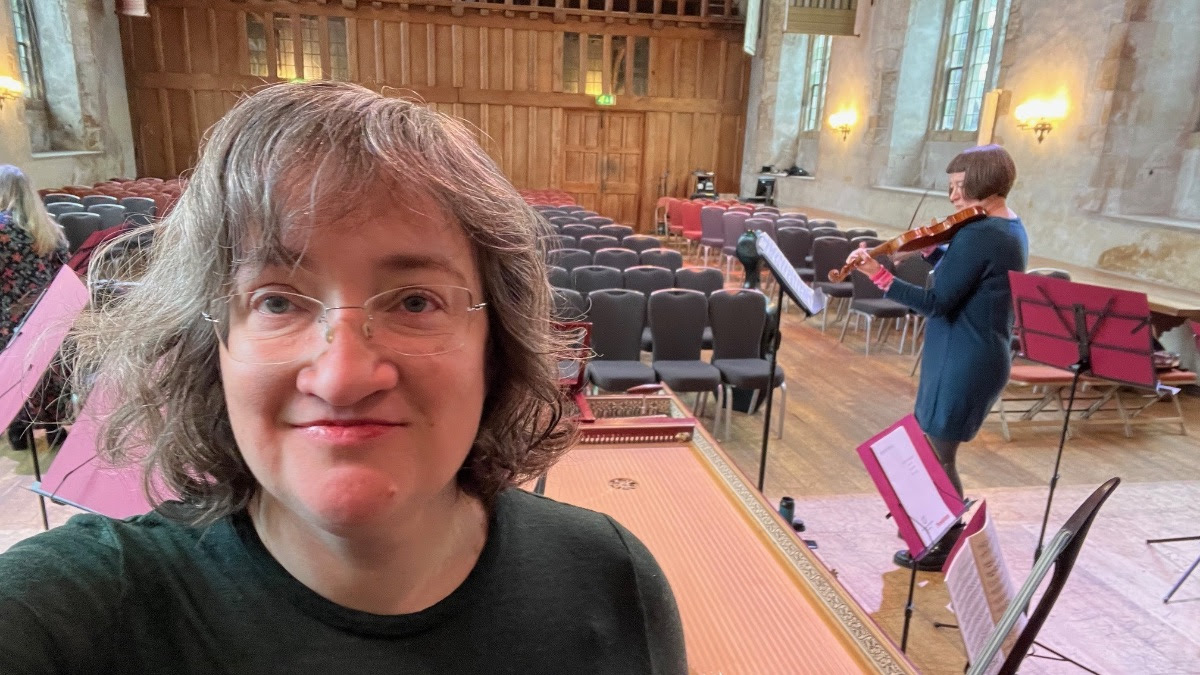
This week I had my performing hat on, playing some wonderful Baroque concerti in Devon. We played in the Great Hall in Dartington, a medieval hall I first played in whilst still in Youth Orchestra. It was great to be back, and I got talking about Feldenkrais with one of my colleagues, who was asking about tension, and whether it would be good for that. I offered to show her, and started by sensing through touch and movement how her hand and forearm moved. Or rather how her brain mapped her forearm. Was it part of the whole arm in her thinking, or a separate piece?
How do you think of yours?
You see for yourself. Try this mini lesson.
1a) Bend the elbow of one arm. Rotate your hand and forearm as if you were turning a door knob. Repeat the movement a few times. Does the upper arm move? Or the shoulder? Or any part of your torso? If it doesn’t, this is an isolated movement. Which is useful to be able to do. But, if making a repetitive movement for any length of time, it’s more useful to have more of yourself involved.
The upper arm muscles, and torso muscles are stronger. You want a hierarchical muscle usage: the big muscles doing more of the heavy lifting, the small muscles doing the fine-tuning.
b) Turn your arm again, but before you do so, tighten the muscles of your upper arm. Then turn your forearm. If you keep the upper arm tight, you’ll be able to feel that the movement stops at the elbow. It will be clearer perhaps that this is an isolated movement. Then let go of the resistance you’ve created and see if more of you moves.
Most people have excess tension in themselves, and it isolates areas of yourselves that could be better integrated.
c) Next, straighten your arm, and make the same movement. You’ll feel the upper arm also rotates. Bend the arm, and hold the upper arm with light fingers of the other hand. Rotate the forearm again, and it should be clearer that the upper arm can move too.
d) Straighten your arm out to the side at shoulder’s height. Make your hand into a gentle fist. Roll your whole arm forwards, like a rolling pin, keeping it at shoulder’s height. Include your shoulder blade and collar bone in the movement. Rotate your arm (the thumb starts to point towards the floor). Feel how your shoulder blade lifts, and the collarbone flattens against the front of your ribs.
e) Roll your arm in the opposite direction, and feel how the shoulder blade slides down at the back. This is a more global movement of the hand – it includes more of the whole limb in the picture.
a) Finally, come back to your starting position, with the elbow bent. Roll the forearm a few times, and see if more of your whole arm has joined in. If it has, this is now a more integrated movement.
 Transform how you move, feel and live