
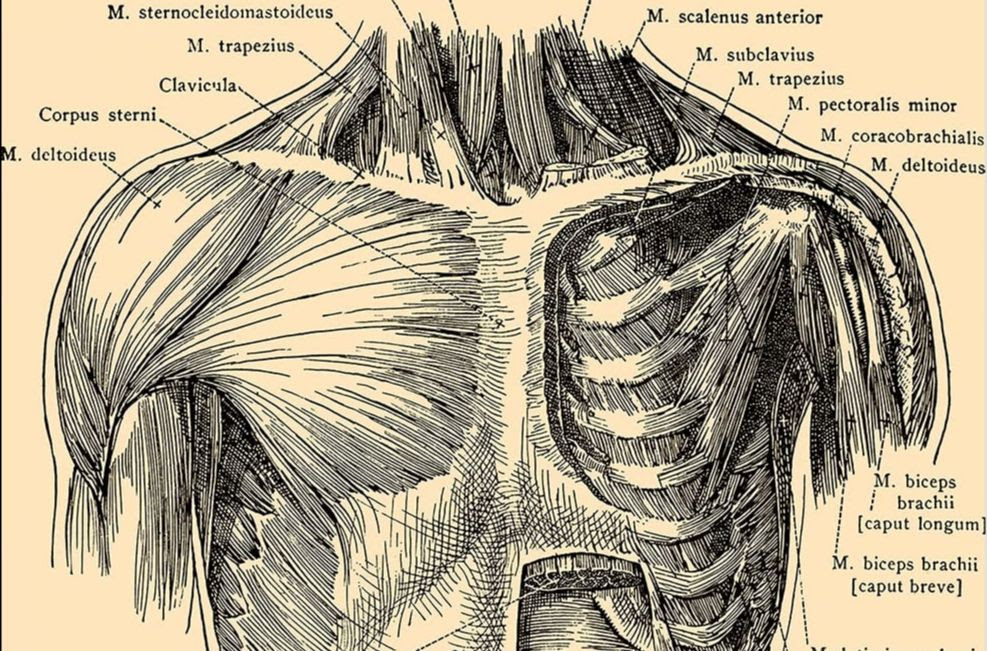
Since becoming a Feldenkrais teacher, now a decade ago, I’ve become more and more fascinated with our anatomy. We’re so fortunate to have access in our digital world to teachers all around the world. I’ve been particularly taken with the dissection work of Gill Hedley. And took some time in the preparation of these lessons to look at the anatomy of the ribs.
The Intercostals muscles get talked about a lot, but what are they and what do they do?
The Intercostals are flat layers of muscles that attach one rib to the one below (or above). The muscles attach directly to bone. (Some muscles don’t do this- they attach to tendons, which then attach to the bone)
They come in 3 layers – external, internal and innermost. The internal layer starts next to the sternum, the external layer at the costochondrial joints. This is where the cartilagenous rib becomes bony rib. It’s about 4 fingers width from the breastbone. The intercostals are in very thin layers, and criss-cross over each other. The external goes on one diagonal, and the internal another. The innermost is at the very back, a strip of muscle, where the spine and ribs meet.
Bone, muscle and fascia.
The ribs are moved by the muscle, and the complexity of movement is allowed by the fascia.
The intercostals and the ribs are sandwiched in two layers of fascia. Each encompassing both the bone and the muscle inside and out- a little vaccuum pack for the ribcage, if you will. The fascial layers allow connection without getting stuck so there can be movement. The different muscles layers slide over each other in a sheering motion.
You might imagine the ribs are evenly spread.
The spaces between our ribs aren’t uniform, or predictable. They get shaped over a lifetime of postural, breathing and moving habits or patterns.
 Transform how you move, feel and live