
What if it’s not really useful to breathe into the belly?
What most people mean when they tell you to breathe into the belly is diaphragmatic breathing- a version of it, to access the lengthening of the lungs as well as outward expansion.
What most people mean by breathing into the belly is diaphragmatic breathing. Belly breathing is a version of it: accessing more air by the lengthening of the lungs. But that’s not always the only effect.
The anatomy of the diaphragm
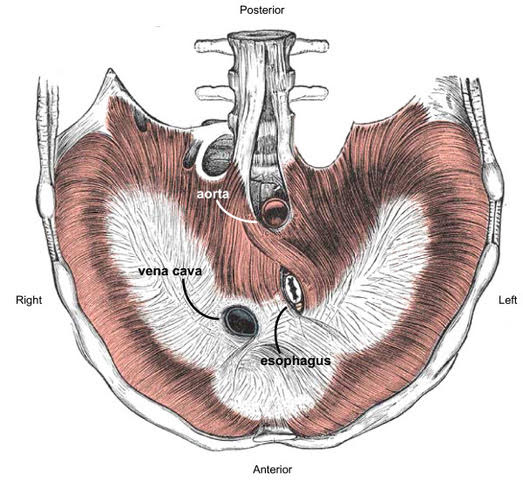
The diaphragm is shaped like a massive kidney bean. It takes up the whole surface area of your cross section at the bottom of the lungs. It’s a little like a trampoline. The central area is tendonous, shaped like a squished heart. Like a trampoline, there’s muscles attached all the way around. From the top edge around to the sides.
In the front it attaches to the costal arch of the front of the ribs, and in the sides and back it attaches the lower ribs. And to the front surface of the spine- so like a kidney shaped trampoline. Imagine you’re sat on the front edge of this trampoline.
What happens to the shape when you breathe into the belly? It tilts down at the front. The elastic bands of the muscles of the front lengthen, and the back ones contract a little.
Try it out yourself.
If you lie down to try this out, most of you will find the back lifts or arches a little away from the floor. Most people already have an arch in their lumbar spine. So every time you breathe in when you use only the belly, you exacerbate it a little more. Which overtime can lead to over constriction of the lower back, and discomfort.
But what if the solution was easy?
The muscles at the front of the diaphragm attach higher than the back. We’re shaped to allow the belly to expand for more than the breath. The muscles of the side and back of the ribs connect to T10-12- the three lowest. And the crura, then tendrils that hook down the front of the spine connect at L1-3. (T=thoracic vertebrae, L=lumbar).
Breathe in, connecting to the back muscles. Push down the back of the diaphragm along the inside of the ribs and front of the spine. Sense that you connect in a very different way.
NB. The diaphragm is involuntary, but we can direct the breath. The bottom of the lungs is continuous with the diaphragm. (The two ‘sleeping-bags’ that both organs live inside are in effect glued together.
Try it for yourself.
We could divide the diaphragm in many ways, but for now divide it in half: front and back.
Push down the front, and feel the response of the back, lifting. What happens in ribs? Or the shoulders? Repeat this a few time.
Then push down the back instead. Elongate the breath down the inside of the back of the ribs. Repeat this until you get the hang of it. Feel how it compresses a completely different part of the intestines. And, it connects with the back muscles, lengthening them. It doesn’t arch the low back, rather straighten or flattens it.
Alternate, a few times breathe, pushing down the front, a few times the back. So you can feel the difference between the two. One arching the back, one lengthening.
Separate the diaphragm into two sides, left and right instead. As you breathe in push down the left side of the diaphragm (with the lengthening of the lungs). Repeat so you can sense more. Aim for lengthening the lungs down towards the side of the hip. Do the ribs change their length one side to the other? How does it change your contact with the floor?
Change over sides, and push down the right side when you breathe in.
What movement does the whole of your diaphragm make?
Imagine your two hands were flat on top of the central tendon of the diaphragm. and elongate the lungs, thinking of pushing down across the whole area. Evenly squishing downwards towards the pelvic “basket”. Like a lift moving downwards. Down towards your pelvic floor.
Feel your insides moving in relation to the ribs and abdomen wall. It’s very different again.
I would say this is what true diaphragmatic breathing is. (Or pelvic breathing as I like to call it is). Using the whole surface of the diaphragm. Not tilting, or employing only some of it.
You may feel your digestive organs responding differently to this new way of lengthening. As more more of your intestines experience the massage of the breath.
This way, you’re elongating both sides of the lungs. The full surface area of your cross-section. And you’re helping the back move with each breath, elongating the back muscles, rather than shortening them.
 Transform how you move, feel and live